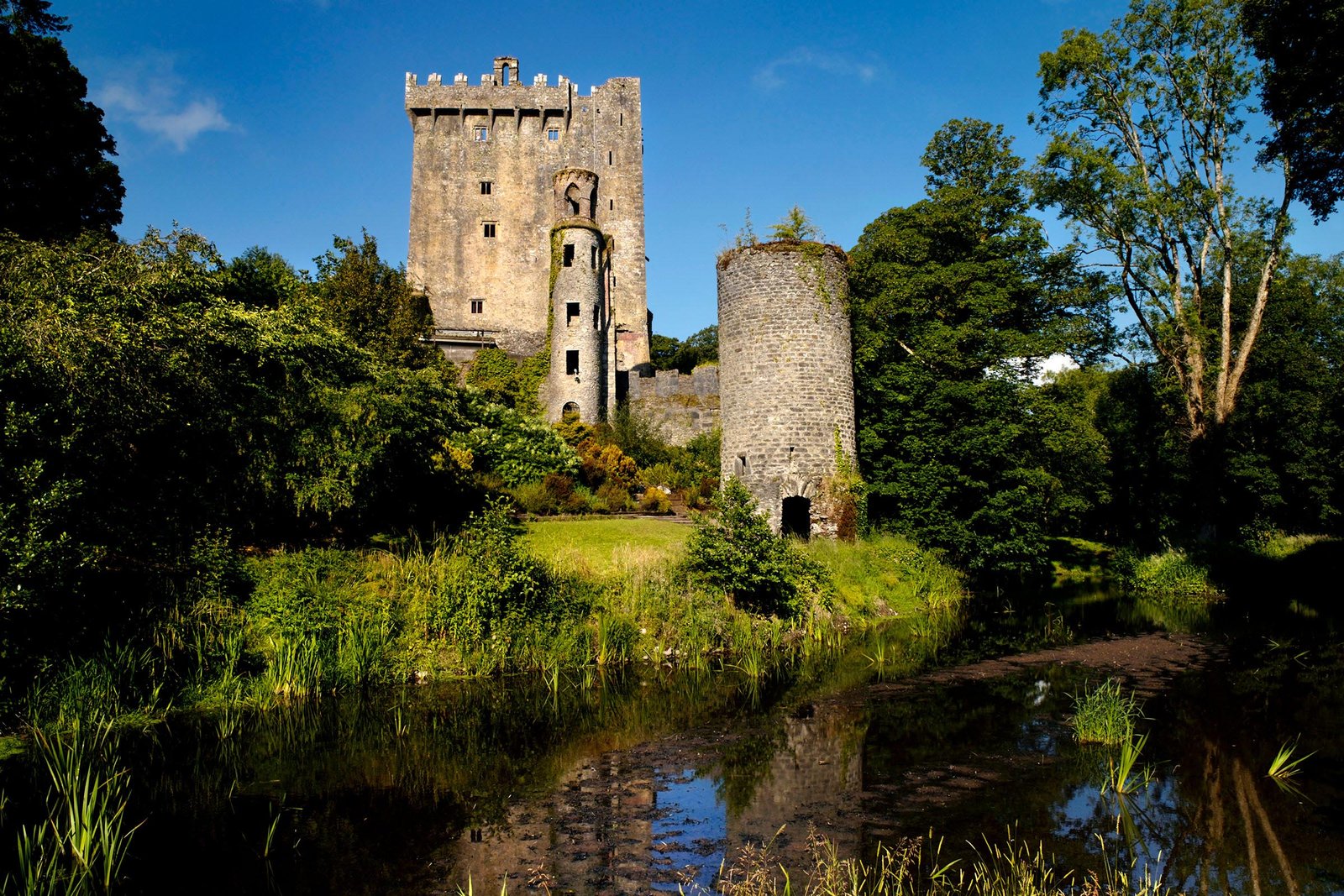
Blarney Castle charges €24 to let you lie on your back on a medieval battlement and kiss a piece of limestone. That sounds like a tourist trap, and for some visitors it is. But the Stone is the least interesting part of the day.
Short version: go for the castle climb and the gardens, treat the kiss as a bonus, and arrive when it opens. The rest of this guide explains why, and how to do it without losing half your day to a queue.
Quick facts
- Where: Blarney, about 8 km north-west of Cork city centre.
- Open: all year round. Hours vary by season: 9am–5.30pm in April and October, 9am–6pm from May to September, 9am–5pm from November to March. Last admission is an hour before closing.
- Tickets: adult €24, student or senior (65+) €19, child (6–16) €12, family of four €65, under-6s free. Online tickets are non-refundable.
- Time needed: the castle recommends three hours. Add queue time if you’re doing the Stone.
- Accessibility: the castle isn’t wheelchair accessible. Part of the grounds is. Only assistance dogs are allowed.
Who it suits, and who should skip it
Good fit: garden and woodland walkers, anyone who likes a proper medieval tower climb, and families with children old enough for steep steps.
Think twice: anyone who can’t manage narrow spiral stairs or dislikes enclosed queues, visitors with only an hour to spare, and anyone expecting a furnished stately home. The castle is a partial ruin, and Blarney House is a separate summer opening.
How bad is the queue?
Visitors’ accounts agree on the pattern. Early opening or late autumn means a short wait. By mid-morning in summer the queue builds to 30–45 minutes, and one visitor reported roughly an hour on a Monday in late May 2026. On busy days, including when cruise passengers arrive, it is reported to reach the castle’s ground floor and out the door.
The gardens, meanwhile, are largely empty because everyone else is queuing for the Stone.
The Stone: what you’re actually signing up for
It’s at the top of the keep. You climb a narrow spiral stair of around 120 steps, worn smooth in places, so wear shoes with grip. At the top you lie on your back and lean backwards over a gap while holding railings, with an attendant helping. An official photo is on sale afterwards, or your companion can take one.
It isn’t dangerous in the way the old stories suggest, when visitors were reportedly held by the ankles. It is undignified, which is rather the point.
The story behind the stone
The legends are better than the stone. One has the Stone as half the Stone of Scone, a gift from Robert the Bruce to the MacCarthys for supporting him at Bannockburn in 1314. Another has a witch rescued from drowning who tells the lord of Blarney to kiss a particular stone. A third says Queen Elizabeth I’s envoy was so worn down by the Lord of Muskerry’s endless smooth excuses for not surrendering the castle that she dismissed it all as “blarney”, which is how the word entered English.
The geology is less romantic. A 2014 University of Glasgow analysis found the Stone is local limestone, roughly 330 million years old, which rules out Scotland. The Bruce story was shaky anyway, since the Stone of Scone had been taken from Scotland in 1296, eighteen years before Bannockburn.
Winston Churchill kissed it in 1912 and Mick Jagger has too. Neither obviously needed the help.
A short history of the castle
The present tower was built in 1446 by Cormac Láidir MacCarthy of the MacCarthy of Muskerry dynasty, on the site of earlier fortifications: a wooden structure, then a stone castle around 1210 that was demolished and its foundations reused. The family had it remodelled in the 1590s. In 1646 Parliamentarian forces under Lord Broghill seized it during the Irish Confederate Wars. It was restored to the MacCarthys after the Restoration, then confiscated after the Williamite War in the 1690s and sold on several times.
Blarney House, the Scottish baronial mansion in the grounds, dates from 1874 and opens to visitors in summer.
What’s in the gardens
The estate covers around 60 acres. These are the parts worth your time:
- Rock Close. A shaded, mossy corner of ancient yews, standing stones, a witch’s kitchen, a dolmen and the Wishing Steps beside a waterfall. Legend says your wish is granted if you take the steps backwards with your eyes closed, so choose a dry day and go slowly. The Witch Stone here is said to bring luck to those who leave an offering. The “druid” billing is part of the site’s own mythology, and I couldn’t find independent archaeological support for it.
- Poison Garden. Next to the battlements, with caged specimens including deadly nightshade and wolfsbane. It’s educational and mildly macabre, a decent combination.
- Fern Garden. In a former quarry, with a hushed, rainforest feel.
- Dungeons and caves beneath the castle, plus lake and riverside walks.
How to plan your visit
Arrive at opening and go to the castle first, before the coach groups. Then walk the Rock Close, Poison Garden and Fern Garden, and finish at the lake, or at Blarney House if it’s open. The castle recommends three hours. Two is tight but doable if you skip the lake and the house.
On a coach or cruise slot, check the queue before committing. If it reaches the ground floor, spend the time in the gardens instead.
By season:
- Spring: the grounds fill with bulbs, and the azalea beds come into flower.
- Summer: longest hours and fullest gardens, but the longest queues. The car park is reported to fill by midday.
- Autumn: quieter. A visitor in late October 2025 reported very few people and a quick kiss.
- Winter: the barest gardens and short daylight, with last admission at 4pm. Be there at opening.
Frequently asked questions
Can I visit without kissing the Stone? Yes. The ticket is the same.
Is the Stone clean? Visitors report it’s cleaned regularly, and some say you can ask the attendant to disinfect it before you kiss it.
Is it suitable for children? Under-6s are free and children aged 6 to 16 pay €12. Children under 16 must be accompanied by an adult. The stairs are narrow and steep, so judge by your child.
Is it any good in the rain? The gardens are. Bring a waterproof. The castle is roofless in places, so the interior can be as wet as outside, and worn stone steps get slippery.
Do I need to book ahead? You can buy at the ticket office on the day. Booking ahead online is sensible in summer, but online tickets are non-refundable.
Blarney village and the Woollen Mills
Blarney’s main attraction after the castle is Blarney Woollen Mills, a large Irish gift and knitwear shop in a mill built in 1823. The mill closed in 1973 and reopened in 1975 as a shop under Christy Kelleher, who had started work there as a boy. The workers’ houses of Millstream Row still stand. Think of it as a souvenir stop with real history behind it.
What to combine it with
- Cobh. About 30 km from Blarney, a 30–40 minute drive. There’s no direct bus, and bus and train via Cork takes about 1½ hours. It has the Titanic Experience and the Cobh Heritage Centre, which covers emigration.
- Fota Island. Home to Fota Wildlife Park, near Cobh. See our Fota Island guide.
- Kinsale. About 30 minutes south of Cork city, with 17th-century forts. Give it its own day.
- Back in Cork. The Blackrock Castle Observatory, Shandon Bells and the Cork Butter Museum all work as an afternoon after a morning at Blarney.
Getting there from Cork
By bus: Bus Éireann route 215 runs from central Cork (St Patrick’s Street and Grand Parade) to Blarney, with regular daytime departures and a journey of around 20–25 minutes. The castle is a short walk from the village stop. Check the TFI journey planner before you go, as roadworks diversions are posted from time to time. See also our guide to public transport in Cork.
By car: about 15–20 minutes from Cork city. Take the N20 north and follow the signs for Blarney.
By taxi: a short hop from the city centre, and a sensible option for a group.
From Dublin: there is no direct train. Day tours exist, but they cram Cork, Cashel and the Stone into one long day, so staying overnight in Cork is kinder to everyone.